Fake Notes: How to Identify Fake Indian Currency Notes
Reviewed by: Fibe Research Team
- Updated on: 15 Sep 2026
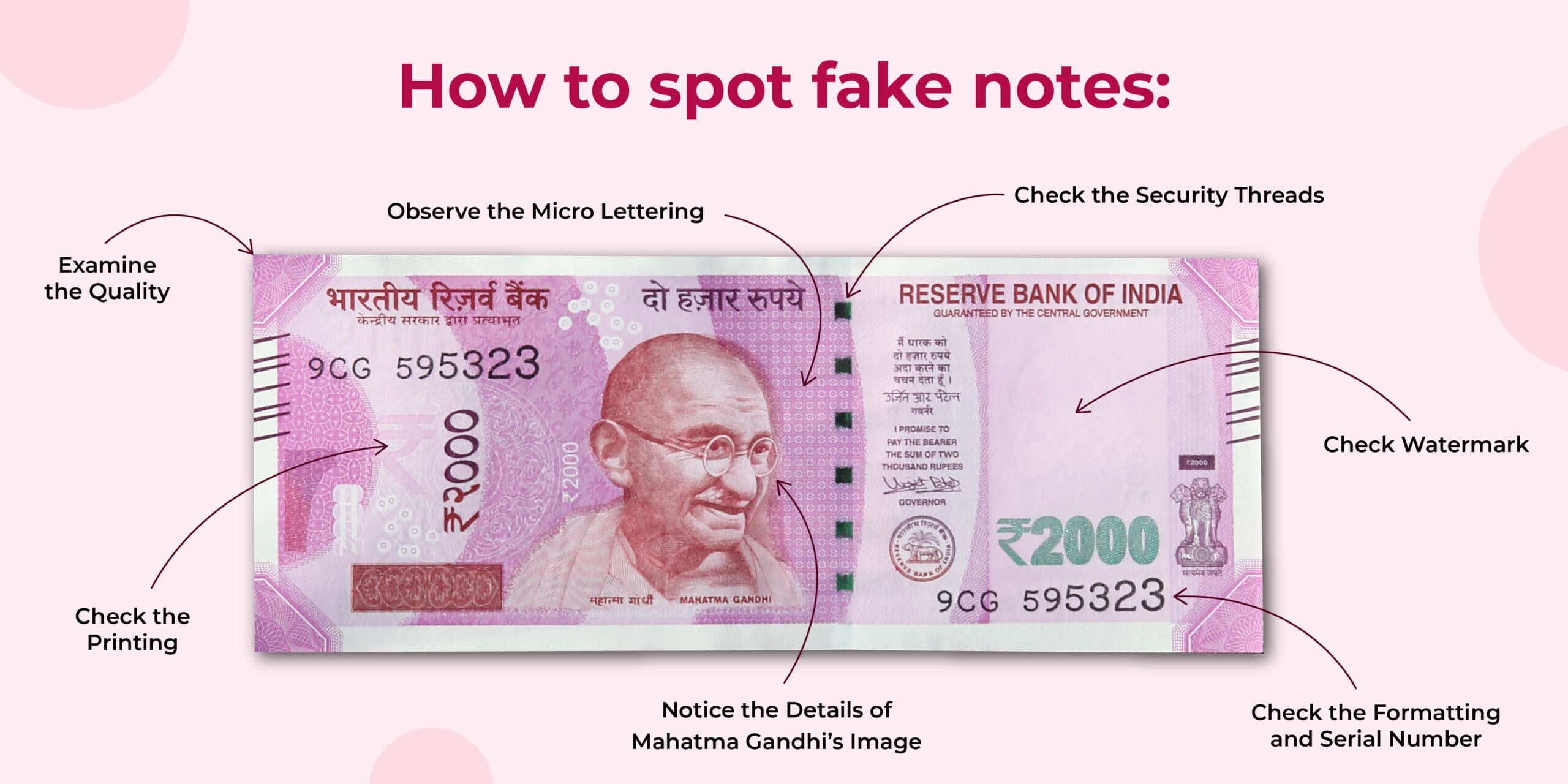
A fake or counterfeit currency note is an unauthorised imitation of a genuine banknote created to resemble legal currency. Counterfeit notes may copy the colour, design, denomination and other visible elements of genuine Indian banknotes, but they may fail to reproduce one or more security features accurately.
Knowing how to identify fake currency is important because accepting a counterfeit note can result in a financial loss, and knowingly trying to circulate one can have legal consequences.
The Reserve Bank of India (RBI) incorporates multiple security features into Indian banknotes to make counterfeiting difficult. These include watermarks, security threads, micro-lettering, raised printing and other denomination-specific features. Checking more than one security feature is a better way to assess a suspicious note than relying on its appearance alone.
Table of Contents
How to Identify Fake Notes: Key Security Features to Check
Genuine Indian banknotes have several visible and tactile security features. While some can be checked with the naked eye, others are easier to examine under a light source or with magnification.
Here are some of the important features you can check when carrying out fake currency identification.
Micro-Lettering
Indian banknotes contain very small lettering at specific locations on the note. Depending on the denomination and series, these micro-letters may include elements such as RBI, भारत, INDIA and the denomination numeral.
To examine micro-lettering:
- Place the note under adequate light.
- Use a magnifying glass, if available.
- Examine the small printed characters around the designated areas of the note.
- Check whether the letters and numerals appear sharp and clearly defined.
Blurred, incomplete or poorly reproduced micro-lettering may be a warning sign. However, you should always check it along with other security features rather than relying on this feature alone.
The RBI confirms that micro-lettering is used at different places on Indian banknotes and is more clearly visible through a magnifying glass.
Mahatma Gandhi Watermark
One of the easiest checks involves the Mahatma Gandhi watermark.
Hold the banknote against a light source. Genuine RBI banknotes contain a Mahatma Gandhi portrait watermark along with an electrotype watermark displaying the denomination.
Since the watermark forms part of the banknote paper during manufacturing, it should appear integrated into the note rather than simply printed on its surface.
A suspicious note may have a watermark that looks:
- Blurry
- Unnaturally dark
- Poorly defined
- Printed rather than embedded
- Missing altogether
The RBI states that the Mahatma Gandhi watermark and denomination watermark are best viewed when the banknote is held against light.
Quality and Paper Texture
The feel of the note can also provide clues.
Contrary to the common belief that Indian currency is made from ordinary paper, the RBI states that the banknote paper currently used in India is made using 100% cotton.
A genuine note therefore has a distinctive texture and feel.
While checking a note, look for:
- Unusually smooth or glossy paper
- Paper that feels too thin or too thick
- Blurred or bleeding ink
- Poorly defined borders or images
- Unusual colour variations
However, an old or heavily circulated genuine note may naturally feel worn. Paper texture should therefore be used along with other security features rather than as the only test.
Security Thread
The security thread is another important feature used in Indian banknotes.
On genuine notes, the security thread is incorporated into the banknote rather than simply being printed as a line on its surface.
For ₹10, ₹20 and ₹50 denomination notes, the security thread carries inscriptions such as भारत and RBI.
For denominations of ₹100 and above, the RBI uses a machine-readable windowed security thread. When the note is tilted, the colour of the thread changes from green to blue.
To check it:
- Hold the note against light.
- Look at the security thread.
- Check whether it forms a continuous line when viewed against light.
- For applicable denominations, tilt the note and observe the colour change.
A line that appears merely printed on top of the paper without the expected security characteristics may indicate a suspicious note.
Formatting and Serial Numbers
The number panels are another useful area to examine.
In Mahatma Gandhi (New) Series banknotes, the numerals in the number panels generally increase in size from left to right, while the first three alphanumeric characters remain constant in size.
Check the note for:
- Poor alignment
- Irregular spacing
- Blurred numbers
- Inconsistent fonts
- Poor print quality
However, it is important to correct a common misconception: two genuine Indian banknotes can have the same serial number.
According to the RBI, two or more banknotes may carry the same serial number if they have a different inset letter, year of printing or RBI Governor’s signature. Therefore, finding the same serial number alone does not prove that a note is fake.
Raised (Intaglio) Printing
Some Indian banknotes use intaglio printing, which produces a raised effect that can be felt by touch.
According to RBI guidance, denominations of ₹100 and above carry raised printing on features such as:
- Mahatma Gandhi’s portrait
- Ashoka Pillar emblem
- Certain identification marks
- Other denomination-specific features
You can lightly run your finger over these areas and check for the expected raised effect.
Remember that this feature varies by denomination and series, so the absence of raised printing on a lower-denomination note does not automatically mean that it is counterfeit.
Colour-Shifting Ink (Optically Variable Ink)
Certain Indian banknotes contain colour-shifting or optically variable ink.
According to the RBI, the denomination numerals on ₹200, ₹500 and ₹2,000 notes use colour-shifting ink. The numeral appears green when the note is held flat and changes towards blue when viewed at an angle.
To check:
- Hold the note normally and observe the applicable denomination numeral.
- Slowly tilt the note.
- Look for the expected green-to-blue colour shift.
The colour-changing effect should appear naturally as the viewing angle changes.
Note: ₹2,000 denomination banknotes were withdrawn from circulation under the RBI’s 2023 withdrawal exercise, but the RBI continues to state that ₹2,000 notes remain legal tender.
What Should You Do If You Receive a Fake Indian Currency Note?
If you suspect that a currency note is counterfeit, do not knowingly attempt to spend it or pass it on to someone else.
You can approach a bank branch for verification or report the matter to the appropriate local authorities.
Under RBI directions, banknotes tendered at bank counters are examined for authenticity using machines. If a bank determines that a note is counterfeit:
- The note will be impounded and will not be returned to the tenderer.
- It will be stamped as a counterfeit note.
- No credit is provided for the counterfeit note.
- The bank must provide an acknowledgement receipt to the person who tendered it.
- The bank follows the prescribed reporting procedure with the police and other authorities.
Avoid trying to use a note once you know or have reason to believe that it is counterfeit.
Financial requirements can arise for several other reasons as well, from medical expenses and travel to home renovation and other personal needs.
If you are looking for funds for such requirements, you can consider a Fibe Personal Loan. Eligible customers can get a loan of up to ₹10 lakh, subject to eligibility and applicable terms. Currently published Fibe terms provide repayment tenure of up to 36 months and nil foreclosure charges.
The application process is digital, and the funds can be used for a variety of eligible personal requirements.
Visit the Fibe website or download the Fibe app to check your eligibility and applicable loan offer.
FAQs on Spotting Fake Indian Currency Notes
1.How can I identify the colour-shifting ink on Indian currency notes?
According to the RBI, the denomination numerals on ₹200, ₹500 and ₹2,000 banknotes use colour-shifting ink. When the applicable numeral is viewed with the note held flat, it appears green. When the banknote is tilted, it changes towards blue.
The ₹2,000 denomination has been withdrawn from circulation, although these notes continue to be legal tender.
2.What are the differences between the old and new series of Indian currency notes?
The Mahatma Gandhi (New) Series introduced changes in the design, dimensions, colours and placement of several security features.
Depending on the denomination, the newer series includes features such as Devanagari denomination numerals, Mahatma Gandhi and electrotype watermarks, security threads, ascending-size numerals in number panels, Swachh Bharat logo and denomination-specific motifs on the reverse.
Security features vary according to the denomination and the series in which the note was issued.
3.How do I report counterfeit currency to the authorities?
If you suspect that you have received a counterfeit note, do not knowingly circulate it. You can approach a bank branch for verification or report it to the appropriate police authorities.
When a bank detects a counterfeit note, RBI directions require the bank to impound it and provide an acknowledgement receipt to the tenderer. The bank then follows the applicable counterfeit-note reporting procedure.
4.What are the legal consequences of using fake currency in India?
The earlier reference to IPC Section 489C needs to be updated. The Bharatiya Nyaya Sanhita, 2023 (BNS) came into force on 1 July 2024 and now contains the relevant provisions.
Under the BNS:
- Section 178 deals with counterfeiting currency notes or banknotes. The offence can attract imprisonment for life or imprisonment of up to 10 years, along with a fine.
- Section 179 covers knowingly using, selling, delivering, receiving or otherwise dealing in counterfeit currency as genuine. It can attract imprisonment for life or imprisonment of up to 10 years, along with a fine.
- Section 180 deals with possession of counterfeit currency when a person knows or has reason to believe it is counterfeit and intends that it be used as genuine. It can attract imprisonment of up to 7 years, a fine, or both. The section also provides that possession established to be from a lawful source does not constitute an offence under that section.
Therefore, accidentally receiving a suspicious note is different from knowingly attempting to use counterfeit currency as genuine.
5.What is the meaning of counterfeit notes?
Counterfeit notes are unauthorised imitations of genuine currency notes created to resemble legal banknotes.
They may copy the design, denomination and appearance of genuine currency but do not originate from the authorised currency-issuing process. Counterfeit notes may also fail to reproduce security features such as watermarks, security threads, micro-lettering and raised printing correctly.
6.How can I identify fake notes without any equipment?
You can perform several basic checks without special equipment:
- Hold the note against light: Look for the Mahatma Gandhi watermark and denomination watermark.
- Tilt the note: Check applicable colour-changing features and security threads.
- Feel the note: On applicable denominations, check the raised printing.
- Look closely: Examine the printing quality, number panels, alignment and security thread.
- Compare it: If possible, compare the suspicious note with a genuine note of the same denomination and series.
Checking several security features together is more reliable than judging the note by just one characteristic.
7.Can banks detect fake notes at the counter?
Yes. RBI directions require banknotes tendered over the counter to be examined for authenticity through machines.
Banks are also required to have appropriate banknote sorting or counterfeit-detection equipment. A note confirmed as counterfeit is impounded rather than returned to the customer, and an acknowledgement receipt is issued.
8.Are there any apps to verify fake Indian currency notes?
There is no RBI app that authenticates a banknote as genuine or counterfeit.
The RBI offers the Mobile Aided Note Identifier (MANI) app, which is designed primarily to help visually impaired persons identify the denomination of Indian banknotes.
However, the RBI specifically states that MANI does not authenticate whether a note is genuine or counterfeit.
Be cautious about third-party apps claiming that a smartphone camera alone can conclusively certify the authenticity of an Indian currency note.
9.What should I do if I receive a fake note from an ATM?
If you suspect that an ATM has dispensed a counterfeit note:
- Do not attempt to spend or circulate the note.
- Keep the suspicious note safely.
- Record the ATM location, date, approximate time and transaction details.
- Preserve the transaction receipt, SMS or account statement, if available.
- Contact the bank that operates the ATM or your bank immediately and raise a complaint.
- Follow the bank’s process for verification and investigation.
RBI directions require banks to ensure that only properly sorted and machine-examined banknotes are loaded into ATMs. RBI also treats the dispensation of counterfeit notes through an ATM as a serious compliance issue and requires banks to maintain mechanisms for handling such complaints.
A complaint does not by itself guarantee reimbursement, so the matter should be reported to the bank promptly with all available transaction details.